

Problem
The Economist serves a global, paying readership that values depth, but even loyal readers are time-poor. A long analysis or a video briefing is exactly what they subscribe for, and also exactly what they skip when the day is busy. The commercial risk is quiet: readers who stop getting value from a subscription eventually stop paying for it.
The goal was to give readers a faster way in, letting them summarise an article or video on demand and ask follow-up questions, without sending them to a generic chatbot that might invent facts or drift off-brand. For a title whose whole value is trustworthy analysis, an assistant that hallucinated would do more harm than good.
Process
The defining decision was that the assistant could only ever speak from The Economist's own words. Early framing imagined a general chat experience; we rejected that fast. The assistant had to be grounded, with every summary and answer tied to the specific article or video in front of the reader, because a wrong or off-brand answer costs more trust than a missing feature.
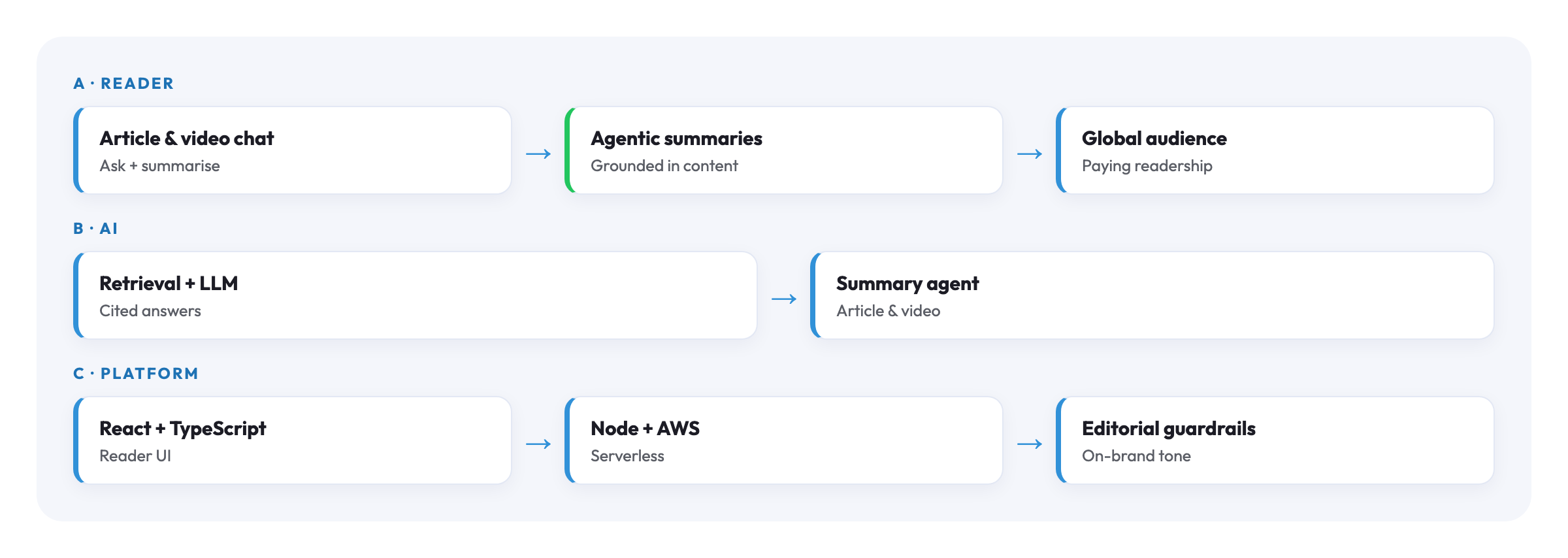
- Agentic summariser. Readers can summarise the article or video they're on, at the length they want, then ask follow-ups. The assistant retrieves the relevant passages and answers only from them.
- Grounded retrieval. Article and video transcripts are indexed so answers cite the source, and the assistant defers rather than guessing when the content doesn't cover a question.
- Editorial guardrails. Prompting and tone constraints keep the assistant sounding like the publication, not a generic bot, which is a hard requirement for a serious international brand.
- Built into the reader UI. Delivered inside the existing React product so it felt native to the reading experience, not bolted on.
Outcome
Readers got a genuinely useful way to get the gist of long articles and video briefings and to interrogate them, without leaving the product or losing the publication's voice. Summaries and answers stayed grounded in The Economist's own content and cited their source, so the feature earned reader trust rather than risking it, and gave a time-poor paying audience more reasons to keep coming back.
"It let readers get to the substance quickly, in our voice, from our reporting, not a generic AI's guess."
Product Lead
Architecture
For engineersTechnical Deep DiveExpand
Grounded, not general
The assistant is a retrieval-augmented agent scoped to the content the reader is viewing. Article text and video transcripts are chunked, embedded and indexed; a query retrieves the relevant passages and the model answers only from them, returning a citation to the source. When the content doesn't support an answer, the assistant says so instead of improvising. That is the single most important behaviour for a trusted publication.
Summaries at the reader's pace
Summarisation is on demand and adjustable, from a one-line gist to a fuller digest, so the reader controls how much depth they want before deciding to read (or watch) in full. The aim was to funnel readers into the reporting, not replace it.
Trade-offs
- Grounding vs coverage. A strictly grounded assistant sometimes declines questions a general model would happily (and wrongly) answer. For this brand that trade is unambiguous: a careful "I can't tell from this article" beats a confident fabrication.
- Latency vs quality. Retrieval plus generation adds latency. Caching common summaries and streaming responses kept the experience fast enough to feel worth using.